This article has 828 words and is a four-minute read.
“It is not the voice of one institution, but the outcome of a collective European dialogue” – Prof. Celia Belim
Defining robust quality criteria for cancer information
The purpose of the European Cancer information Portal is to provide citizens with equal access to reliable, evidence-based cancer information in multiple languages. To achieve this, a dedicated team of experts is developing a set of clearly defined quality criteria and standards for accurate, trustworthy and user-friendly content. This article explores the implementation of a Delphi panel in this process – a structured communication approach that involves a panel of selected experts. We covered the role of patients and patient representatives in defining the quality criteria in this recent article here.
At this stage the team already generated a preliminary catalogue of quality criteria comprising 20 main criteria and 80 sub-criteria. These criteria will be iteratively refined involving researchers and patient representatives. Such a set of quality criteria is a first for Europe and can be used by other digital platforms in Europe and beyond. For EU-CiP, these standards guide the work of project partners in identifying and evaluating information sources that feed into the portal.
At some point in our lives, most of us will be affected by cancer – either directly or experienced by loved ones. Cancer incidences are rising all over Europe with a projected number of 3.25 Million new incidences per year in 2040. Not knowing where to find trustworthy guidance on cancer prevention, diagnosis, treatment and support can cause additional stress in an already life-changing situation. The vast number of information sources we are confronted with, further complicate the search for trustworthy information.
The EU-CiP project is building a European Cancer information Portal (EU-CiP) that will be a digital home for reliable, easy-to-access cancer information for citizens across Europe. By providing information addressing all stages of a person’s cancer journey in one place, the portal will empower patients, caregivers, families and friends to make informed decisions about their life and health. This reflects EU-CiP’s commitment to improving the quality of life for everyone affected by cancer.
Delphi Panel
Developing quality criteria for the information presented on the portal follows a clear, inclusive strategy. The process follows several steps including a review of scientific literature, the establishment of a Delphi panel, and, critically, focus group and survey input from patient organisations.
The EU-CiP Quality Criteria Delphi panel comprises 71 experts from across Europe. The panel was established with strong support from the consortium partners who shared invitations through their networks and took part themselves. Based on results from focus groups and surveys, the experts on the Delphi Panel will iteratively refine the quality criteria in up to three Delphi rounds over four months.
The panel includes experts in communication, digital and eHealth technologies, ethics, health literacy, health policy and public health, medical and health sciences (including oncology) and social sciences and humanities. This reflects the various aspects that need to be considered when building a portal that meets the needs of the users.
The challenge in this process is to integrate diverse voices into a common set of recognised quality standards. This is where the Delphi panel plays a key role by providing a structured approach, as Prof. Belim describes:
“The Delphi panel is the moment when everything comes together. What began as a wide and diverse collection of voices – from patients, researchers, clinicians and European partners – is being gradually distilled into a shared set of quality standards that experts can recognise as legitimate.
“Through anonymous rounds and structured feedback, participants are able to reflect freely, challenge assumptions and move towards real consensus. This is what is giving the framework its authority: it is not the voice of one institution, but the outcome of a collective European dialogue.”
The Delphi method is particularly appropriate for developing quality criteria with European policy and normative relevance. By using anonymous and structured feedback, it promotes equity of voices, supports independent reflection and enhances balanced expert judgement. Participation in all rounds is essential to ensure the final criteria are robust, legitimate and valid.
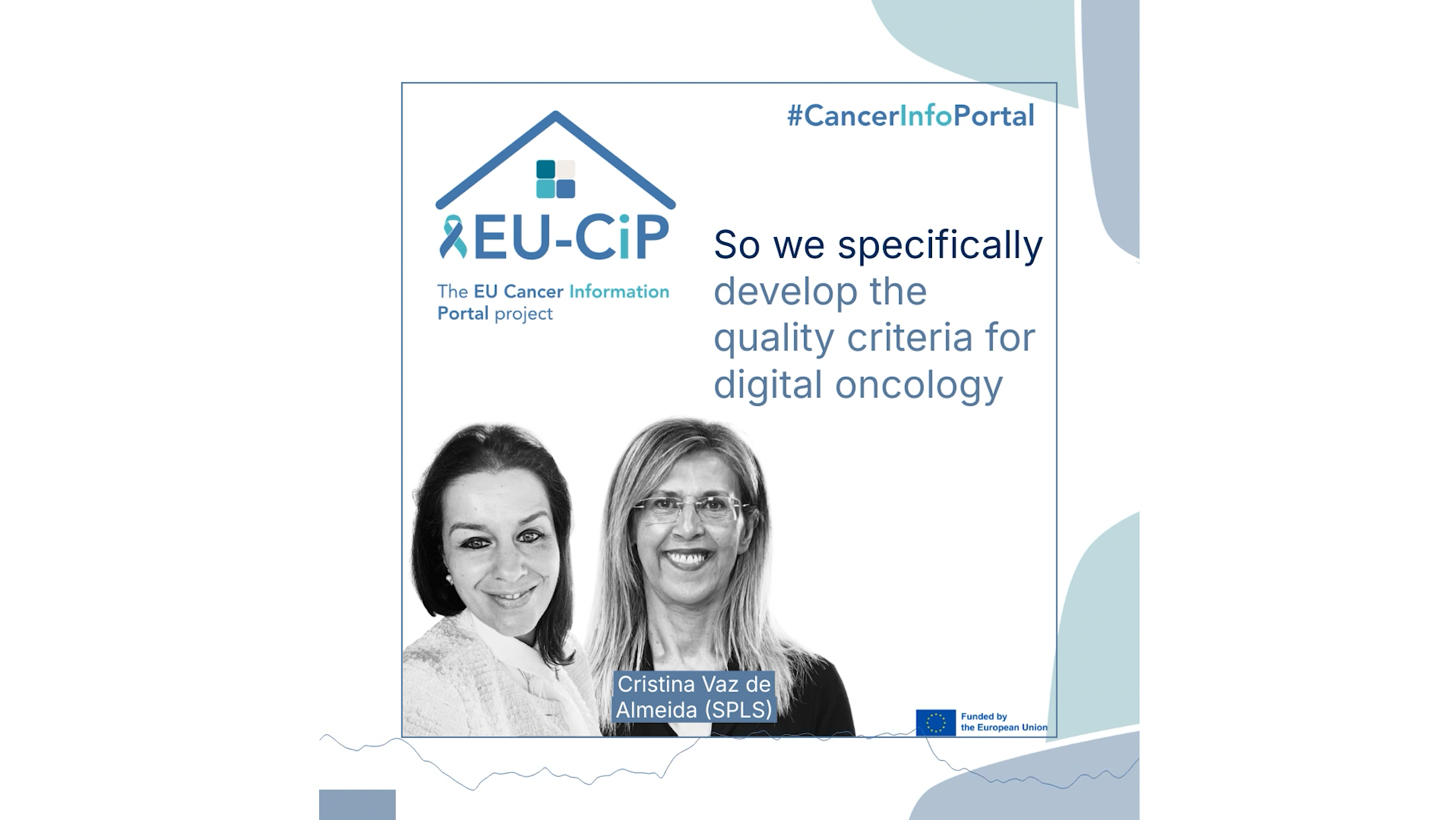
In fact, the strength of the Delphi panel – as Prof. Vaz de Almeida notes – lies in its ability to build shared standards through collective agreement:
“In a field as sensitive as cancer information, consensus cannot be imposed – it has to be built. The Delphi panel is allowing us to bring together different disciplines, countries and perspectives and to progressively transform them into common ground. What is emerging is more than a technical model; it is a European reference for trustworthy, ethical and human-centred cancer information.”
Clear quality criteria for cancer information represent one of the fundamental building blocks of the EU Cancer information Portal. Explore more about how we build the portal here and follow us on our socials for updates (LinkedIn, Facebook, Instagram, Bluesky, Threads).
Further reading:
‘Compassionate, accessible and real’: How patients are defining the EU Cancer information Portal